
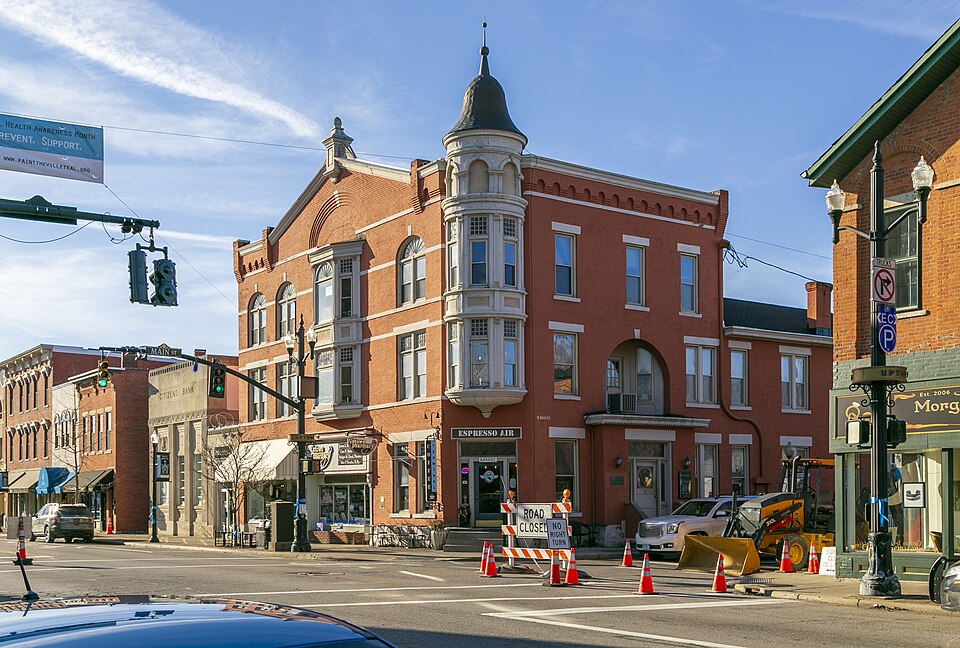
Westerville is a city in Franklin and Delaware counties in the U.S. state of Ohio. A northeastern suburb of Columbus, its population was 39,190 at the 2020 census. The city is home to Otterbein University. It was once known as the "Dry Capital of the World" for its strict laws prohibiting sales of alcohol and for being the home of the Anti Saloon League, one of the driving forces behind the Prohibition era at the beginning of the 20th century.
At a Glance
- Counties: Franklin County and Delaware County
- State: Ohio
History of Westerville
Cultures have inhabited the Westerville area for several millennia. Paleo Indians and their successor cultures inhabited the area between Big Walnut Creek and Alum Creek. The Wyandotte were the primary inhabitants by the time Europeans arrived, living along Alum Creek. They were forced out of Ohio in 1843.
The land that is today Westerville was settled by those of European ancestry around 1810. Garrit Sharp and his family were the first to establish a residence in what is now Westerville city limits and the settlement was known as Sharp’s Settlement. In 1818, Matthew, Peter, and William Westervelt, settlers of Dutch extraction, migrated to the area from New York. Matthew Westervelt donated land for the construction of a Methodist church in 1836, and the settlement was subsequently named in the family’s honor. In 1839, the Blendon Young Men’s Seminary was chartered in Westerville; Matthew Westervelt was one of its first trustees. The Church of the United Brethren in Christ bought the seminary in 1846, and the next year the seminary was reformed, and renamed Otterbein College after the church’s founder Philip William Otterbein. It continues today in Westerville as the private Otterbein University.
Text adapted from the Wikipedia article Westerville, Ohio, available under the CC BY-SA 4.0 license.