
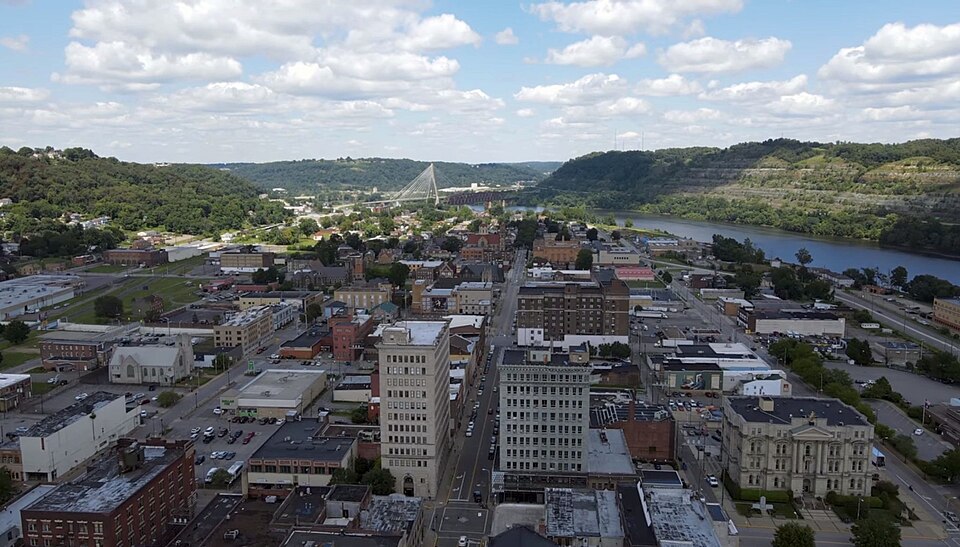
Steubenville ( STEW bən vil) is a city in Jefferson County, Ohio, United States, and its county seat. The city is located on the eastern border of Ohio along the Ohio River, abutting the northern panhandle of West Virginia and 33 miles (53 km) west of Pittsburgh, Pennsylvania. Steubenville had a population of 18,161 at the 2020 census. The Weirton, Steubenville metropolitan area has an estimated 113,000 residents. The city’s name is derived from Fort Steuben, a 1786 fort that sat within the city’s current limits and was named for Prussian military officer Baron Friedrich Wilhelm von Steuben.
At a Glance
- County: Jefferson County
- County seat of Jefferson County
- State: Ohio
History of Steubenville
In 1786 to 87, soldiers of the First American Regiment under Major Jean François Hamtramck built Fort Steuben to protect the government surveyors mapping the land west of the Ohio River. The fort was named in honor of Baron Friedrich Wilhelm von Steuben, a Prussian army officer who reformed the Continental Army during the American Revolution. When the surveyors completed their task a few years later, the fort was abandoned. In the meantime, settlers had built homes around the fort; they named their settlement Steubenville. The town was sometimes referred to as La Belle City, a franglais interpretation of "The Beautiful City".
On July 29, 1797, Jefferson County was organized by a proclamation of Governor Arthur St. Clair, and Steubenville was selected as the county seat. It was platted in the same year by Bezaliel Wells and James Ross, the city’s co founders. Wells, a government surveyor born in Baltimore, received about 1,000 acres (4 km2) of land west of the Ohio River; Ross, a lawyer from Pittsburgh, owned the land north of Wells.
On March 1, 1803, Ohio was admitted to the Union as the 17th state. During the first half of the nineteenth century, Steubenville was primarily a port town, and the rest of the county was small villages and farms. Steubenville received a city charter in 1851. In 1856, Frazier, Kilgore and Company erected a rolling mill (the forerunner of steel mills) and the Steubenville Coal and Mining Company sank a coal shaft. The city was a stop along the Pittsburgh, Cincinnati, Chicago and St. Louis Railroad, which connected Pittsburgh to Chicago and St. Louis.
Text adapted from the Wikipedia article Steubenville, Ohio, available under the CC BY-SA 4.0 license.