
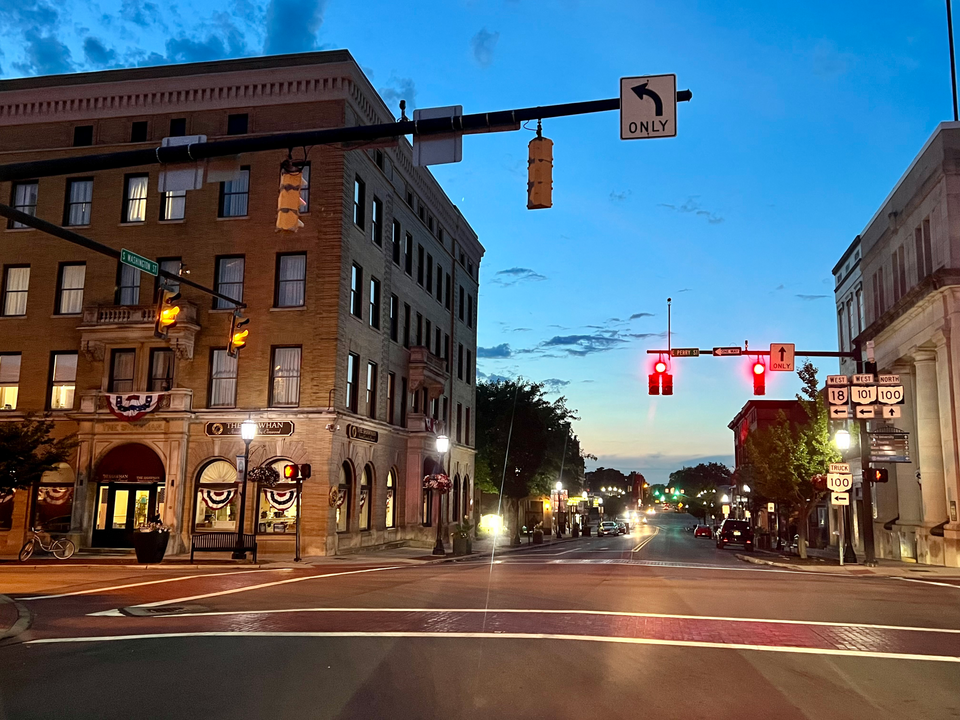
Tiffin is a city in Seneca County, Ohio, United States, and its county seat. Developed along the Sandusky River, Tiffin is located about 55 miles (89 km) southeast of Toledo. The population was 17,953 at the 2020 census.
It is the home of Heidelberg University and Tiffin University. At one time the city was noted as a glass and porcelain manufacturing center. The National Arbor Day Foundation has designated Tiffin as a Tree City USA.
At a Glance
- County: Seneca County
- County seat of Seneca County
- State: Ohio
History of Tiffin
The bronze statue of "The Indian Maiden" on Frost Parkway near Miami Street, marks the site of Fort Ball, a military depot of the War of 1812. During a fighting engagement of that war, Erastus Bowe sighted the location where Tiffin later developed. In 1817, he returned to the site and built the Pan Yan Tavern on the North Sandusky River. Its name was likely derived from Penn Yan, New York. Early homesteaders followed soon after Bowe, and the settlement of Oakley sprang up around the Pan Yan on the north side of the river. The chief road of the area followed the path of the stagecoaches through Oakley, which was called Fort Ball after 1824.
In 1821, Josiah Hedges purchased a piece of land on the south bank of the river opposite Oakley and founded another settlement. He named this village in honor of Edward Tiffin, first governor of Ohio and later a member of the United States Senate who had helped gain statehood for the Ohio Territory in 1803. Tiffin was incorporated by an act of the Ohio Legislature on March 7, 1835. In March 1850, Fort Ball was absorbed by Tiffin.
In 1824, with the establishment of Seneca County by the Ohio Legislature, Tiffin was designated as the county seat. The county was named after the Seneca people, the westernmost of the Iroquois League of Six Nations who dominated the territory for centuries.
Text adapted from the Wikipedia article Tiffin, Ohio, available under the CC BY-SA 4.0 license.