
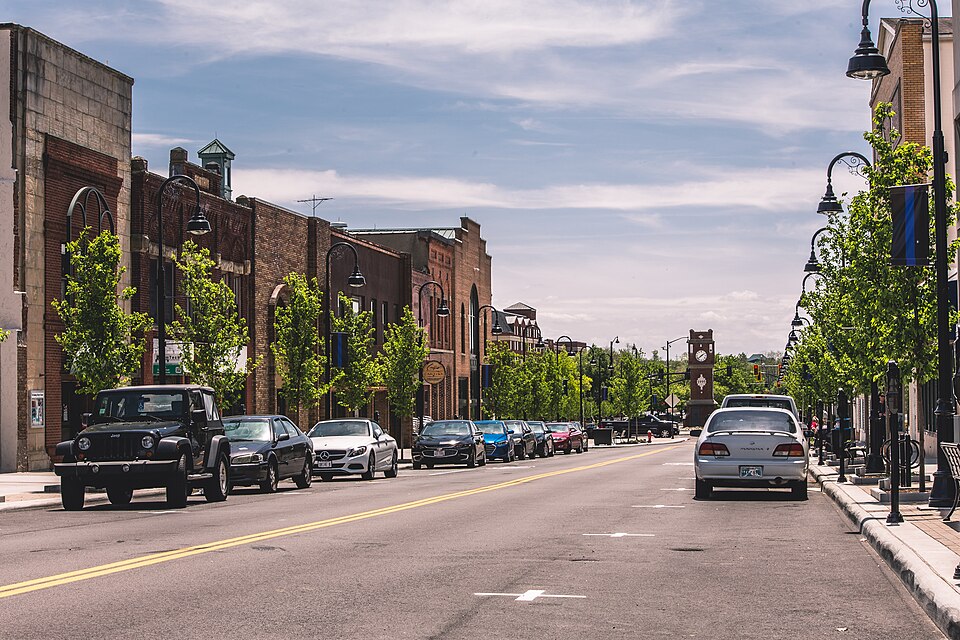
Cuyahoga Falls ( KY ə HOH gə or KY ə HOG ə) is a city in Summit County, Ohio, United States. The population was 51,114 at the 2020 census. The second largest city in Summit County, it is located directly north of Akron and is a suburb in the Akron metropolitan area. The city was founded in 1812 by William Wetmore and was originally named Manchester, but renamed for the Cuyahoga River and the series of waterfalls that run along the southern boundary of the city.
At a Glance
- County: Summit County
- State: Ohio
History of Cuyahoga Falls
Cuyahoga Falls was formed in 1812 near the junction of what was then Northampton, Stow, Tallmadge, and Portage townships. The focus was the series of Cuyahoga River waterfalls that provided power for manufacturing.
In 1812, Kelsey and Wilcox built a dam on the Cuyahoga River at a place where a railroad bridge crossed it in 1876. They then built a flour mill, an oil mill, and a saw mill. This led to the construction of a number of houses. This area was known as the old village. Development moved downstream, though, when the power was discovered to be better there. The old village was eventually destroyed in 1826, when a dam built by William Wetmore flooded the dam at the old village and its mills were torn down.
The earliest settlers of Cuyahoga Falls included Joshua Stow and William Wetmore. In 1815, a saw mill was operating near Gaylord’s Grove, using power generated by a dam on the Cuyahoga River there.
Text adapted from the Wikipedia article Cuyahoga Falls, Ohio, available under the CC BY-SA 4.0 license.